Menopause Mercy
Giving Yourself Grace When Everything Feels Like Too Much

A Personal Note
I’ll be honest — I didn’t see the rage coming. It wasn’t loud at first. It was the quiet kind that lived behind my ribs, a low vibration of resentment and exhaustion that I couldn’t name. One minute I was holding it all together, and the next I was breaking down over something small. When I finally slowed down enough to listen, I realized the rage wasn’t about chaos or hormones — it was about boundaries. It was the part of me that had gone unheard for years, rising to say no more. The rage was my body’s way of teaching me to speak up for myself — to say, “This is too much,” and to mean it without apology.
“You are a nervous system in transition.”
“Rage is not a moral failure. Rage is data.”
“When the rage rises… pause + feel your body. Then choose kindness for yourself.”
Menopause is not just “a phase.”
It’s a full-body, full-heart initiation.
The body changes. Sleep shatters. Joints ache. Brain fog rolls in. And then there’s the rage—that flash of “who am I right now?” that can feel bigger than you, sharper than you, and sometimes aimed at the people you love most.
You are not broken. You are not “too much.”
You are a nervous system in transition.
In Mycelopause, we speak of menopause as a mycelial crossroads: hormones, history, trauma, caregiving, culture, and unmet needs all lit up at once. Rage and tenderness growing from the same root system, asking for light.
This piece is your reminder—and your map—for menopause mercy: how to give yourself grace in the middle of body storms and mental chaos, and how that mercy can become compassion for others too.
Rage, Anger & “I Don’t Feel Like Myself”

Recent research confirms what so many of us are living:
Hormonal shifts in perimenopause and menopause are linked with irritability, anger, and problems regulating emotion, not just sadness. (APA Monitor, 2023)
One study found that aging and reproductive stage both significantly affect measures of anger, with “state” and “trait” anger peaking during reproductive-aging transitions. (Woods et al., Seattle Midlife Women’s Health Study, 2025)
Additional findings show that low estrogen correlates with changes in serotonin and dopamine that may underlie irritability and aggression during menopause. (PauseLife article, 2023)
In the Mycelopause frame, we treat rage as:
a guardian (something in you saying “no more”), and
a signal (something in you needing safety, boundaries, and rest).
The work is not to shame the rage. The work is to listen to it without letting it burn you or everyone else down.
That starts in the body.
The Menopause Mercy Map
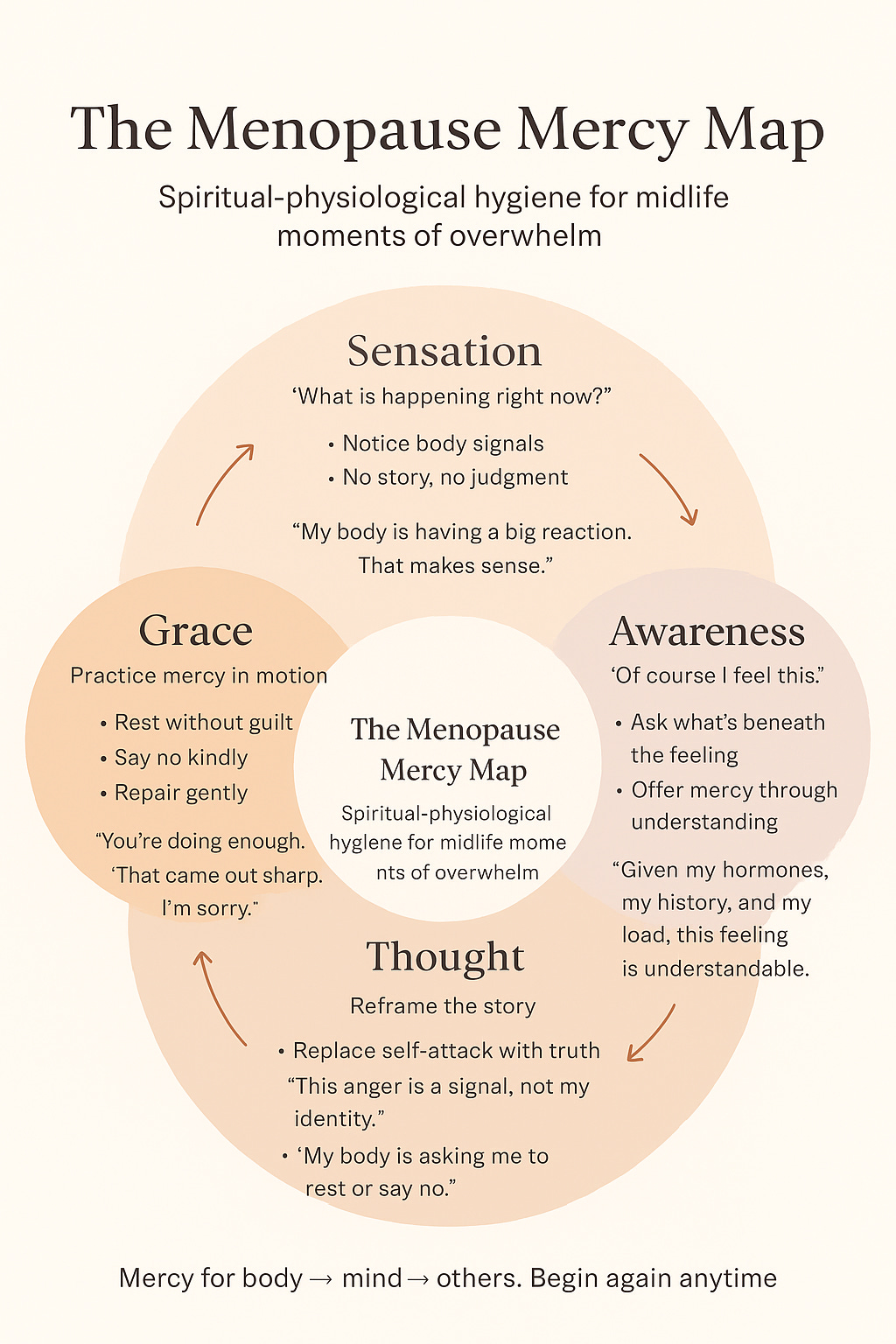
From sensation → awareness → thought → discipline → grace
Here is a simple 5-step practice set you can use when your body, mood, and mind feel out of control. Think of it as spiritual-physiological hygiene: small, repeatable, kind.
1. Start with the body: “What is happening right now?”
When a wave hits (hot flash, jab of joint pain, spike of anger):
Pause for a few seconds.
Gently scan:
Is my jaw tight?
Is my chest hot?
Is my heart racing?
Is my stomach clenched?
Then say (out loud if you can):
“My body is having a big reaction. That makes sense.”
No story yet. No judgment. Just accurate noticing.
2. Add awareness: “Of course I feel this.”
Following trauma-healing guides (like Gabor Maté), we shift from “What’s wrong with me?” to “What happened to me + what’s happening in me?”
Ask:
What else might be under this? Exhaustion? Feeling unseen? Old patterns of being the ‘good one’?
If my best friend felt this, would it seem ‘too much’ or totally understandable?
This step is mercy in sentence form:
“Given my hormones, my history, and my load, this feeling is understandable.”
When you normalize the feeling, your nervous system softens. The charge begins to drop.
3. Reframe the thought: from attack to information
Anger often runs an old script:
“I’m failing.”
“Everyone is ungrateful.”
“I’m losing it.”
Trade those for kinder, truer thoughts:“This anger is a signal, not my identity.”
“My body is asking me to stop, to rest, or to say no.”
“Something in me needs protection and care.”
Reframing is not spiritual bypass. It’s truth-telling plus tenderness.
You’re not denying the pain; you’re choosing a lens that doesn’t crush you.
4. Use breath & visualization to interrupt the spiral
Now we introduce simple tools that your mid-life brain and body can actually use when overwhelmed.
Try this 60-second practice:
Inhale gently through the nose for 4.
Exhale through the mouth for 6.
As you exhale, picture:
roots growing from your feet into the earth, or
A soft circle of light around your heart.
Silently repeat:
“I am allowed to pause.”
“I am safe enough in this moment.”
Do 5 rounds. That’s it.
What it does:
Lengthened exhale signals your nervous system to downshift.
Visualization gives your mind a job that is soothing, not spiraling.
Over time, this becomes a discipline of mercy—a practiced pathway back home.
5. Practice tiny acts of grace (for you, then for others)
Grace is not a feeling. It’s a muscle.
Try one small, concrete act a day:
Let yourself lie down for 10 minutes without feeling guilty about it.
Say “I can’t do that today” once, without a 4-paragraph apology.
Place your hand on your chest and say:
“You’re doing enough.”When you snap at someone, repair with:
“That came out sharp. I’m overwhelmed. I’m sorry.”
As you practice grace inward, something softens. Then, slowly, there is more room for grace outward—to partners, kids, colleagues.
Mercy for your changing body → mercy for your tender mind → mercy for your people.
In that order.
Where Psilocybin Micro-Dosing Fits: A Door to Loving Awareness
At Mycelopause, we explore how psychedelic tools, when safe, legal, and intentional, may support this transition journey.
Early and emerging evidence suggests:
Psilocybin (in clinical higher-dose settings) can enhance emotional flexibility, empathy, and reduce depression/anxiety.
Micro-dosing psilocybin (tiny, sub-perceptual doses) has been associated with improved mood, emotional resilience, and healthier habits in anecdotal reports, although research is still in its early stages.
In the words of Ram Dass, the shift from “I am this” to “I am loving awareness” applies to self and others.
How this ties into menopause mercy:Think of micro-dosing (where legal, medically appropriate) not as escape, but as a door-opener:
It may soften rigid self-attack.
It may make it easier to notice sensations, pause, and choose kinder thoughts.
It pairs beautifully with mindfulness and the practices mentioned above.
Important truths:
Micro-dosing is not a cure; it’s not FDA-approved for menopause; it’s not risk-free.
It should only be considered where legal, medically supervised, especially if you have a bipolar history, psychosis, or are on certain meds.
The medicine doesn’t do the integration for you—the work still lies in breath, body, boundaries, reflection, and support.
Think of it as: You grow the pathways. Medicine might light them, but you still walk them.
If you remember nothing else, remember this:
When the rage rises, when your body feels foreign, when your mind is cruel:
Pause + feel your body.
Tell yourself it makes sense.
Choose a kinder thought.
Breathe and visualize safety.
Do one tiny act of mercy for yourself.
This is menopause mercy.
Not perfection. Not silence. Not “getting over it.”
It’s about learning to stay with yourself—curious, kind, and a little freer—while everything around you changes.
If you’d like once-a-week reflections, gentle prompts, and midlife community, subscribe to Mycelopause.
Sign up now for more reflections and tools at Mycelopause
Join our community for weekly wisdom, science, and soul work, and permission to feel everything while cultivating kindness for yourself.
(Subscribe and share with a friend who needs this.)
Thank you for being here. You’re doing it. You’re changing.
And you’re worthy of grace
Written by Dr Patricia Singh, Co-Founder Trip HōM and Co-Author Mycelopause